
🌐 Language: English | 中文版 → 📖 Read Online → — Sidebar nav, dark mode & full-text search. Better than raw GitHub.
QueryEngine: The Brain of Claude Code
Source files:
QueryEngine.ts(1,296 lines),query.ts(1,730 lines),query/directory
TL;DR
QueryEngine is the central orchestrator of Claude Code's entire lifecycle. It owns the conversation state, manages the LLM query loop, handles streaming, tracks costs, and coordinates everything from user input processing to tool execution. The core loop in query() is a deliberately simple while(true) AsyncGenerator — all intelligence lives in the LLM, the scaffold is intentionally "dumb."
1. Two Layers: QueryEngine (Session) + query() (Turn)
The engine is split into two layers with distinct lifetimes:

| Layer | Lifetime | Responsibility |
|---|---|---|
QueryEngine | Per conversation | Session state, message history, cumulative usage, file cache |
query() | Per user message | API loop, tool execution, auto-compaction, budget enforcement |
The QueryEngine Class
export class QueryEngine {
  private config: QueryEngineConfig
  private mutableMessages: Message[]        // Full conversation
  private abortController: AbortController  // Interrupt signal
  private permissionDenials: SDKPermissionDenial[]
  private totalUsage: NonNullableUsage      // Cumulative tokens
  private readFileState: FileStateCache     // File content LRU
  private discoveredSkillNames = new Set<string>()

  async *submitMessage(prompt, options?): AsyncGenerator<SDKMessage> {
    // ... 900+ lines of orchestration
  }
}2. The submitMessage() Lifecycle
Each call to submitMessage() follows a precise sequence:
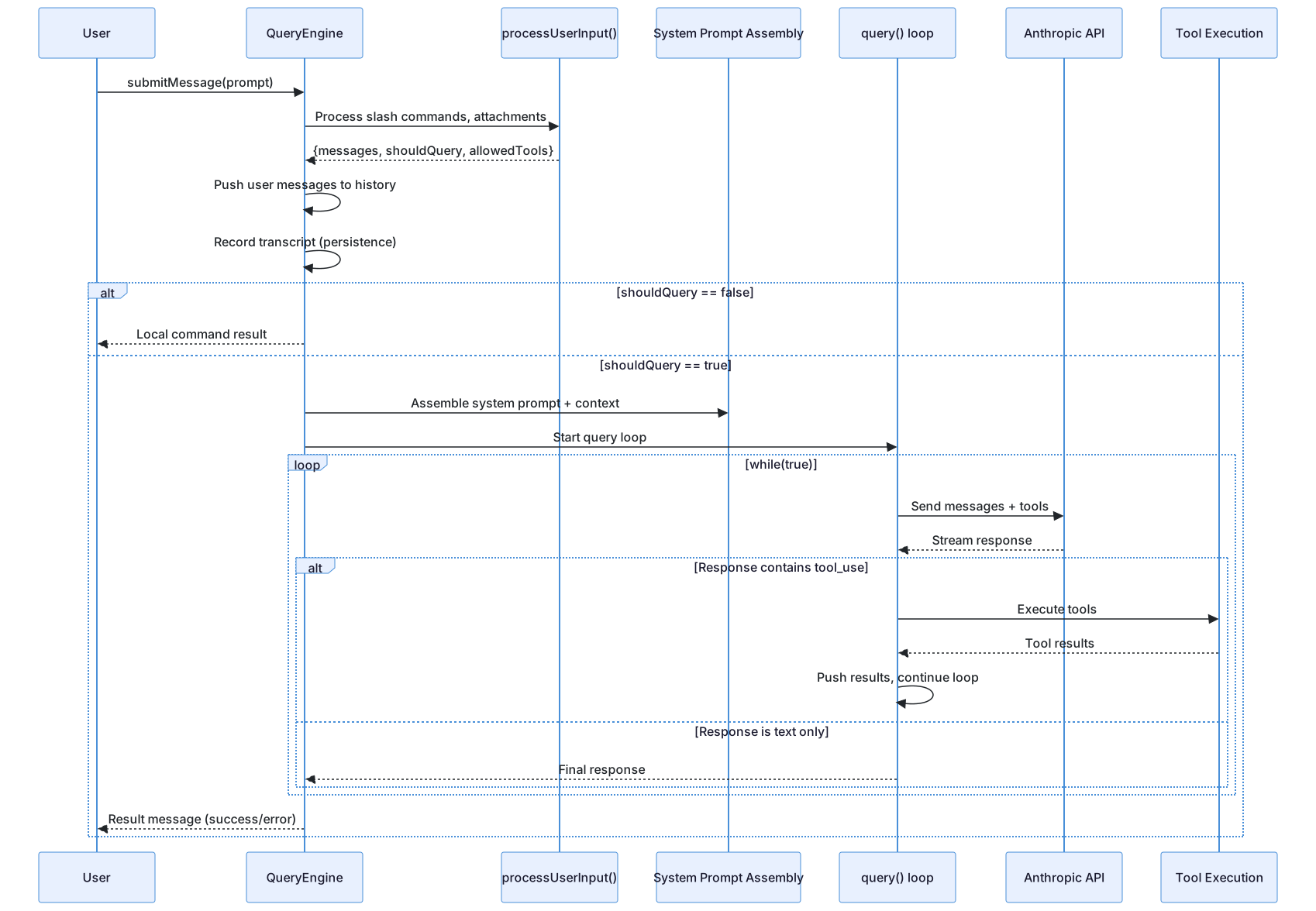
Phase 1: Input Processing
const { messages, shouldQuery, allowedTools, model, resultText } =
  await processUserInput({
    input: prompt,
    mode: 'prompt',
    context: processUserInputContext,
})processUserInput() handles:
- Slash commands (
/compact,/clear,/model,/bug, etc.) - File attachments (images, documents)
- Input normalization (content blocks vs. plain text)
- Tool allowlisting from command output
If shouldQuery is false (e.g., /clear), the result is returned directly without calling the API.
Phase 2: Context Assembly
Before calling the API, the system prompt is assembled from multiple sources:
const { defaultSystemPrompt, userContext, systemContext } =
  await fetchSystemPromptParts({
    tools: tools,
    mainLoopModel: initialMainLoopModel,
    additionalWorkingDirectories: [...],
    mcpClients: mcpClients,
    customSystemPrompt: customPrompt,
  })

// Inject coordinator context if in coordinator mode
const userContext = {
  ...baseUserContext,
  ...getCoordinatorUserContext(mcpClients, scratchpadDir),
}

// Layer: default/custom + memory mechanics + append
const systemPrompt = asSystemPrompt([
  ...(customPrompt ? [customPrompt] : defaultSystemPrompt),
  ...(memoryMechanicsPrompt ? [memoryMechanicsPrompt] : []),
  ...(appendSystemPrompt ? [appendSystemPrompt] : []),
])Phase 3: The query() Loop
The core loop is a while(true) AsyncGenerator:
for await (const message of query({
  messages,
  systemPrompt,
  userContext,
  systemContext,
  canUseTool: wrappedCanUseTool,
  toolUseContext: processUserInputContext,
  maxTurns,
  taskBudget,
})) {
  // Handle each yielded message...
}Phase 4: Result Extraction
After the loop ends, the engine extracts the final result:
const result = messages.findLast(
  m => m.type === 'assistant' || m.type === 'user',
)

if (!isResultSuccessful(result, lastStopReason)) {
  yield { type: 'result', subtype: 'error_during_execution', ... }
} else {
  yield { type: 'result', subtype: 'success', result: textResult, ... }
}3. The query() Loop: 1,730 Lines of Controlled Chaos
The query() function in query.ts is the heart of tool execution. Despite being 1,730 lines, its core structure is simple:
while (true) {
    1. Pre-process: snip → microcompact → context collapse → autocompact
    2. Call API: stream response
    3. Post-process: execute tools, handle errors
    4. Decision: continue (tool_use) or terminate (end_turn)
}The Pre-Processing Pipeline
Before each API call, messages pass through a multi-stage compression pipeline:

| Stage | Purpose | Feature Gate |
|---|---|---|
| Tool result budget | Cap aggregate tool output size, persist to disk | Always |
| Snip | Remove stale conversation segments | HISTORY_SNIP |
| Microcompact | Cache-aware editing of past messages | CACHED_MICROCOMPACT |
| Context collapse | Archive old turns, project collapsed view | CONTEXT_COLLAPSE |
| Autocompact | Full conversation summarization when near token limit | Always (configurable) |
Streaming Tool Execution
Tools can execute concurrently during streaming:
const streamingToolExecutor = new StreamingToolExecutor(
  toolUseContext.options.tools,
  canUseTool,
  toolUseContext,
)When a tool_use block arrives in the stream, the executor begins execution immediately — before the full response finishes. This overlaps tool execution with API streaming.
Budget Enforcement
The loop enforces three budget types:
// 1. USD budget
if (maxBudgetUsd !== undefined && getTotalCost() >= maxBudgetUsd) {
  yield { type: 'result', subtype: 'error_max_budget_usd', ... }
  return
}

// 2. Turn budget
if (turnCount >= maxTurns) {
  yield { type: 'result', subtype: 'error_max_turns', ... }
  return
}

// 3. Token budget (per-turn output limit)
if (feature('TOKEN_BUDGET')) {
  checkTokenBudget(budgetTracker, ...)
}4. State Management: The Message Switch
Inside submitMessage(), a large switch statement routes each message type:
switch (message.type) {
  case 'assistant':     // LLM response → push to history, yield to SDK
  case 'user':          // Tool results → push to history, increment turn
  case 'progress':      // Tool progress → push and yield
  case 'stream_event':  // Raw SSE events → usage tracking, partial yields
  case 'attachment':    // Structured output, max_turns, queued commands
  case 'system':        // Compact boundaries, API errors, snip replay
  case 'tombstone':     // Message removal signals
  case 'tool_use_summary': // Aggregated tool summaries
}Key design: every message type goes through the same yield pipeline. There are no side channels — the AsyncGenerator is the single communication path.
5. The ask() Convenience Wrapper
For one-shot usage (headless/SDK mode), ask() wraps QueryEngine:
export async function* ask({ prompt, tools, ... }) {
  const engine = new QueryEngine({
    cwd, tools, commands, mcpClients,
    initialMessages: mutableMessages,
    readFileCache: cloneFileStateCache(getReadFileCache()),
    // ... 30+ config options
  })

  try {
    yield* engine.submitMessage(prompt, { uuid: promptUuid })
  } finally {
    setReadFileCache(engine.getReadFileState())
  }
}The try/finally ensures the file state cache is always saved back — even if the generator is terminated mid-stream.
6. Error Recovery Mechanisms
The query loop handles several error recovery paths:
Fallback Model
If the primary model fails, the loop retries with a fallback:
try {
  for await (const message of deps.callModel({ ... })) { ... }
} catch (error) {
  if (error instanceof FallbackTriggeredError) {
    // Tombstone orphaned messages from failed attempt
    for (const msg of assistantMessages) {
      yield { type: 'tombstone', message: msg }
    }
    // Reset and retry with fallback model
    assistantMessages.length = 0
    attemptWithFallback = true
  }
}Max Output Tokens Recovery
When the model hits output token limits, the loop attempts up to 3 retries:
const MAX_OUTPUT_TOKENS_RECOVERY_LIMIT = 3Reactive Compaction
If prompt-too-long errors occur, reactive compaction can compress the conversation on-the-fly.
Transferable Design Patterns
The following patterns from QueryEngine can be directly applied to any system that orchestrates LLM interactions.
Pattern 1: AsyncGenerator as Communication Protocol
The entire engine communicates through yield. No callbacks, no event emitters, no message buses. The AsyncGenerator provides:
- Backpressure: consumer controls pace
- Cancellation:
.return()propagates throughyield* - Type safety:
AsyncGenerator<SDKMessage, void, unknown>
Pattern 2: Mutable State with Immutable Snapshots
this.mutableMessages.push(...messagesFromUserInput)
const messages = [...this.mutableMessages] // Snapshot for query loopThe engine maintains a mutable message array (for persistence across turns) but takes immutable snapshots for each query loop iteration.
Pattern 3: Permission Wrapping via Closure
const wrappedCanUseTool: CanUseToolFn = async (tool, input, ...) => {
  const result = await canUseTool(tool, input, ...)
  if (result.behavior !== 'allow') {
    this.permissionDenials.push({
      tool_name: sdkCompatToolName(tool.name),
      tool_use_id: toolUseID,
      tool_input: input,
    })
  }
  return result
}Permission tracking is injected transparently — the query loop doesn't know it's being monitored.
Pattern 4: Watermark-Based Error Scoping
const errorLogWatermark = getInMemoryErrors().at(-1)
// ... later, on error:
const all = getInMemoryErrors()
const start = errorLogWatermark ? all.lastIndexOf(errorLogWatermark) + 1 : 0
errors = all.slice(start).map(_ => _.error)Instead of counting errors (which breaks when the ring buffer rotates), the engine saves a reference to the last error and slices from there. Turn-scoped errors without a counter.
8. Cost and Token Tracking: Every Cent Accounted For
Every API call costs real money. The cost tracking system acts as the financial ledger of the entire session — accumulating costs per-model, integrating with OpenTelemetry, and persisting across session resumptions.
// 源码位置: src/cost-tracker.ts:278-323
The Accumulation Pipeline
Each time the API returns a response, addToTotalSessionCost() fires a multi-step accounting process:
export function addToTotalSessionCost(
  cost: number, usage: Usage, model: string,
): number {
  // 1. Update per-model usage map (input, output, cache read/write tokens)
  const modelUsage = addToTotalModelUsage(cost, usage, model)
  // 2. Increment global state counters
  addToTotalCostState(cost, modelUsage, model)

  // 3. Push to OpenTelemetry counters (if configured)
  const attrs = isFastModeEnabled() && usage.speed === 'fast'
    ? { model, speed: 'fast' } : { model }
  getCostCounter()?.add(cost, attrs)
  getTokenCounter()?.add(usage.input_tokens, { ...attrs, type: 'input' })
  getTokenCounter()?.add(usage.output_tokens, { ...attrs, type: 'output' })

  // 4. Recursive advisor cost — nested models (e.g., Haiku for classification)
  let totalCost = cost
  for (const advisorUsage of getAdvisorUsage(usage)) {
    const advisorCost = calculateUSDCost(advisorUsage.model, advisorUsage)
    totalCost += addToTotalSessionCost(advisorCost, advisorUsage, advisorUsage.model)
  }
  return totalCost
}Per-Model Usage Map
// 源码位置: src/cost-tracker.ts:250-276
The system tracks usage at model granularity. Each model gets its own running tally:
| Field | Source |
|---|---|
inputTokens | usage.input_tokens |
outputTokens | usage.output_tokens |
cacheReadInputTokens | usage.cache_read_input_tokens |
cacheCreationInputTokens | usage.cache_creation_input_tokens |
webSearchRequests | usage.server_tool_use?.web_search_requests |
costUSD | Accumulated dollar cost |
contextWindow | Model-specific context window size |
maxOutputTokens | Model-specific max output limit |
Session Persistence and Restoration
// 源码位置: src/cost-tracker.ts:87-175
Costs survive session resumptions (--resume). When a session is saved, all accumulated state is written to the project config. On resume, restoreCostStateForSession() re-hydrates the counters — but only if the session ID matches. This prevents cross-session cost contamination:
if (projectConfig.lastSessionId !== sessionId) {
  return undefined  // Don't mix costs from different sessions
}9. Error Recovery: The Art of Graceful Degradation
Error handling in the query loop is not an afterthought — it's the second-largest subsection of
query.ts. The system implements a multi-layered retry and recovery architecture that turns transient failures into invisible blips.
The withRetry Engine
// 源码位置: src/services/api/withRetry.ts:170-517
withRetry() is an AsyncGenerator that wraps every API call with sophisticated retry logic:
API Call → Error?
  ├── 429 (Rate Limited) → Retry with exponential backoff (base 500ms, max 32s)
  ├── 529 (Overloaded)   → Retry if foreground source; bail if background
  ├── 401 (Auth failed)  → Refresh OAuth token, clear API key cache, retry
  ├── 403 (Token revoked) → Force token refresh, retry
  ├── ECONNRESET/EPIPE   → Disable keep-alive, reconnect
  ├── Context overflow    → Calculate safe max_tokens, retry
└── Other 5xx → Standard exponential retryForeground vs Background: Not All Queries Are Equal
// 源码位置: src/services/api/withRetry.ts:57-89
A critical optimization: 529 errors only retry for foreground queries. Background tasks (summaries, title generation, classifiers) bail immediately on 529 to avoid amplifying a capacity cascade:
// Only these sources retry on 529:
const FOREGROUND_529_RETRY_SOURCES = new Set([
  'repl_main_thread', 'sdk', 'compact',
  'agent:custom', 'agent:default', 'agent:builtin',
  'auto_mode', 'hook_agent', 'hook_prompt', ...
])

// Non-foreground → instant bail
if (is529Error(error) && !shouldRetry529(options.querySource)) {
  throw new CannotRetryError(error, retryContext)
}Fallback Model Trigger
// 源码位置: src/services/api/withRetry.ts:327-364
After 3 consecutive 529 errors, the system triggers a FallbackTriggeredError. The query loop catches this, tombstones orphaned messages, strips thinking signatures (which are model-bound), and retries with the fallback model.
Persistent Retry Mode (UNATTENDED_RETRY)
// 源码位置: src/services/api/withRetry.ts:91-104, 477-513
For unattended sessions, the system retries 429/529 indefinitely with up to 5-minute backoff, chunking the wait into 30-second heartbeat intervals. Each heartbeat yields a SystemAPIErrorMessage so the host environment doesn't mark the session as idle:
let remaining = delayMs
while (remaining > 0) {
  yield createSystemAPIErrorMessage(error, remaining, attempt, maxRetries)
  const chunk = Math.min(remaining, HEARTBEAT_INTERVAL_MS)  // 30s
  await sleep(chunk, options.signal, { abortError })
  remaining -= chunk
}max_output_tokens Recovery (Three-Stage Escalation)
// 源码位置: src/query.ts:1188-1256
When the model hits its output token limit, the loop escalates through three strategies:
Stage 1: Escalate to 64K tokens (one-shot upgrade)
Stage 2: Inject recovery message (up to 3 attempts)
         → "Output token limit hit. Resume directly — no apology, no recap."
Stage 3: Recovery exhausted → surface the error to the userThe recovery message explicitly tells the model to avoid apologizing or recapping — because that wastes more tokens and makes the problem worse.
10. Streaming Architecture: Avoiding the O(n²) Trap
The choice between Anthropic's SDK-level
BetaMessageStreamand raw SSE processing isn't academic — it's a performance cliff that matters at scale.
// 源码位置: src/services/api/claude.ts:1266-1280
Why Raw SSE Over SDK Streams?
The SDK's BetaMessageStream accumulates content blocks by rebuilding the entire message object on each delta. For a response with 10,000 characters, this means O(n²) string concatenation. Claude Code instead processes the raw SSE stream directly:
SDK BetaMessageStream:  message_start → rebuild full message → delta → rebuild again → ...
Raw SSE Processing: content_block_delta → append only the delta → track state incrementallyThe streaming pipeline uses an incremental state machine:
message_start→ Initialize message structurecontent_block_start→ Create a new block (text, tool_use, or thinking)content_block_delta→ Append delta text to the current block (O(1) per delta)content_block_stop→ Finalize the blockmessage_stop→ Complete, extract usage stats
Stream Idle Watchdog
// 源码位置: src/services/api/claude.ts (stream processing)
A 90-second idle watchdog aborts streams that stall without producing data. This prevents the system from hanging indefinitely on a dead connection:
Stream data received → Reset timer
90s without data → Abort signal → Retry via withRetry11. Context Collection: What Claude Knows About Your World
Before any API call, the system assembles a rich picture of the user's environment. This context is memoized, prefetched during idle windows, and security-gated to prevent untrusted code execution.
// 源码位置: src/context.ts:116-189
Two Context Sources
| Source | Function | Contents |
|---|---|---|
| System Context | getSystemContext() | Git status, branch, recent log, user name |
| User Context | getUserContext() | CLAUDE.md files, current date |
Git Status: Parallel Collection
// 源码位置: src/context.ts:60-110
Git metadata is collected with Promise.all() for maximum parallelism:
const [branch, mainBranch, status, log, userName] = await Promise.all([
  getBranch(),
  getDefaultBranch(),
  execFileNoThrow(gitExe(), ['--no-optional-locks', 'status', '--short'], ...),
  execFileNoThrow(gitExe(), ['--no-optional-locks', 'log', '--oneline', '-n', '5'], ...),
  execFileNoThrow(gitExe(), ['config', 'user.name'], ...),
])The --no-optional-locks flag is critical: it prevents git from acquiring the index lock, avoiding conflicts with the user's concurrent git operations.
Status output is truncated at 2,000 characters — a dirty repo with hundreds of changed files shouldn't blow up the context window.
Memoize + Manual Invalidation
Both context functions use lodash memoize() for "compute once, cache forever" semantics. When the underlying data changes (e.g., system prompt injection), the cache is manually cleared:
export function setSystemPromptInjection(value: string | null): void {
  systemPromptInjection = value
  getUserContext.cache.clear?.()
  getSystemContext.cache.clear?.()
}Security-First Prefetching
// 源码位置: src/main.tsx:360-380
Git commands can execute arbitrary code through core.fsmonitor and diff.external hooks. The system only prefetches git context after trust has been established:
function prefetchSystemContextIfSafe(): void {
  if (isNonInteractiveSession) {
    void getSystemContext()  // Non-interactive: trust is implicit
    return
  }
  const hasTrust = checkHasTrustDialogAccepted()
  if (hasTrust) void getSystemContext()
  // Otherwise: DON'T prefetch — wait for trust
}12. Message Normalization: The Invisible Translator
The internal message format and the API wire format are not the same thing.
normalizeMessagesForAPI()bridges this gap — merging, filtering, and transforming messages into what the API expects, all while preserving prompt cache integrity.
// 源码位置: src/utils/messages.ts:1989+
What Normalization Does
Internal Messages → normalizeMessagesForAPI() → API-ready Messages
  - Merge consecutive same-role messages
  - Filter out progress/system/tombstone messages
  - Strip deferred tool schemas (ToolSearch optimization)
  - Normalize tool inputs for API compatibility
- Handle thinking block placement constraintsThe Immutable Message Principle
// 源码位置: src/query.ts:747-787
Messages sent to the API must remain byte-identical across turns — any change invalidates the prompt cache. The system enforces this through clone-before-yield:
// Original message is NEVER mutated — it flows back to the API as-is
let yieldMessage = message
if (message.type === 'assistant') {
  // Only clone if backfill adds NEW fields (not overwrites)
  const addedFields = Object.keys(inputCopy).some(k => !(k in block.input))
  if (addedFields) {
    clonedContent ??= [...message.message.content]
    yieldMessage = { ...message, message: { ...message.message, content: clonedContent } }
  }
}Thinking Block Constraints
The API enforces three strict rules for thinking blocks that normalizeMessagesForAPI() must respect:
| Rule | Constraint | Penalty for Violation |
|---|---|---|
| Thinking requires budget | Messages containing thinking blocks must appear in queries with max_thinking_length > 0 | 400 error |
| Thinking can't be last | A thinking block must NOT be the final block in a message | 400 error |
| Thinking persists across tool use | Thinking blocks must be preserved throughout the assistant's trace — spanning tool_use/tool_result boundaries | Silent corruption |
As the source code comments put it: "不遵守这些规则的惩罚:一整天的调试和揪头发。" (Penalty for violating these rules: a full day of debugging and hair-pulling.)
13. CLI Bootstrap: From Binary to Query Loop
Source coordinates: src/entrypoints/cli.tsx (303 lines, 39KB)
Before QueryEngine ever runs, the CLI entrypoint decides what to run. This is not a simple argument parser — it's a multi-path dispatcher optimized for startup latency.
The Fast-Path Architecture
async function main(): Promise<void> {
  const args = process.argv.slice(2)

  // Fast-path 1: --version → zero imports, instant exit
  if (args[0] === '--version') { console.log(MACRO.VERSION); return }

  // Fast-path 2: --dump-system-prompt → minimal imports
  // Fast-path 3: --claude-in-chrome-mcp → MCP server mode
  // Fast-path 4: --computer-use-mcp → Computer Use MCP
  // Fast-path 5: --daemon-worker → lean worker (no configs/analytics)
  // Fast-path 6: remote-control|rc|bridge → Bridge mode
  // Fast-path 7: daemon → long-running supervisor
  // Fast-path 8: ps|logs|attach|kill|--bg → background sessions
  // Fast-path 9: new|list|reply → template jobs
  // Fast-path 10: environment-runner → headless BYOC
  // Fast-path 11: self-hosted-runner → self-hosted polling
  // Fast-path 12: --worktree --tmux → exec into tmux
  // ...
  // Default: load full CLI → cliMain() → QueryEngine
}Three Design Principles
1. Dynamic import() everywhere: Every fast-path uses await import() instead of top-level imports. The --version path has zero module imports — it prints MACRO.VERSION (build-time inlined) and exits instantly.
2. feature() gates for dead code elimination: Each fast-path is wrapped in feature('FLAG') checks. At build time, Bun's bundler eliminates entire code blocks for disabled features, so external builds never include internal-only paths like ABLATION_BASELINE or DAEMON.
3. profileCheckpoint() for startup instrumentation: Every path records its checkpoint — enabling precise startup latency measurement across all entry vectors.
The Ablation Baseline Easter Egg
// Inlined here (not init.ts) because BashTool/AgentTool capture
// module-level consts at import time — init() runs too late
if (feature('ABLATION_BASELINE') && process.env.CLAUDE_CODE_ABLATION_BASELINE) {
  for (const k of [
    'CLAUDE_CODE_SIMPLE', 'CLAUDE_CODE_DISABLE_THINKING',
    'DISABLE_INTERLEAVED_THINKING', 'DISABLE_COMPACT',
    'DISABLE_AUTO_COMPACT', 'CLAUDE_CODE_DISABLE_AUTO_MEMORY',
    'CLAUDE_CODE_DISABLE_BACKGROUND_TASKS',
  ]) {
    process.env[k] ??= '1'
  }
}This is a harness-science L0 ablation — it strips every intelligent optimization (thinking, compact, auto-memory, background tasks) to measure the raw LLM baseline. It must run before any module evaluation because tools capture env vars into constants at import time.
Summary
| Aspect | Detail |
|---|---|
| QueryEngine | 1,296 lines, per-conversation lifecycle, owns message history + usage |
| query() | 1,730 lines, per-turn while(true) loop with tool execution |
| Communication | Pure AsyncGenerator — no callbacks, no events |
| Pre-processing | 5-stage compression pipeline (budget → snip → MC → collapse → autocompact) |
| Budget limits | USD, turns, tokens — all enforced in the loop |
| Error recovery | withRetry (429/529/401 matrix), fallback model, max-output escalation (3x), persistent retry |
| Cost tracking | Per-model addToTotalSessionCost(), OpenTelemetry counters, session-scoped persistence |
| Streaming | Raw SSE over SDK streams (avoids O(n²)), 90s idle watchdog |
| Context | Memoized git parallel collection, security-gated prefetch, 2K status truncation |
| Messages | normalizeMessagesForAPI() — immutable originals, clone-before-yield, thinking block rules |
| Key principle | "Dumb scaffold, smart model" — the loop is simple, intelligence is in the LLM |
Previous: ← 00 — OverviewNext: → 02 — Tool System